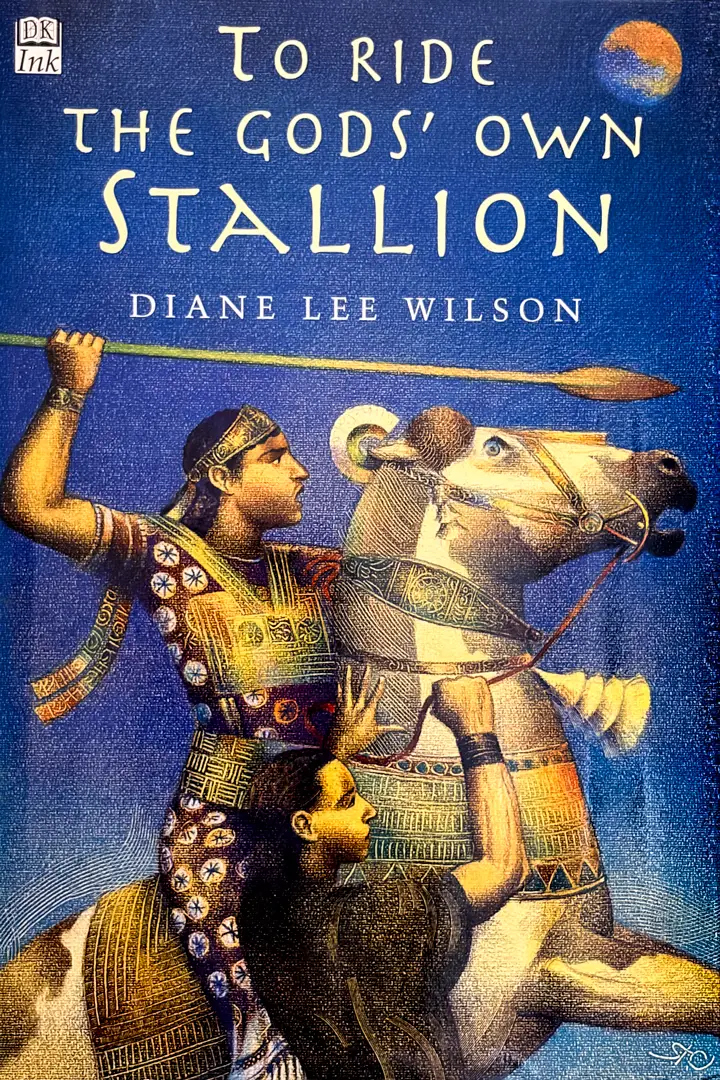
Description
A note from the author
Every time I hear modern news about Iraq, I’m transported back to Nineveh and the Assyrian world of To Ride the Gods’ Own Stallion. Like today, battles raged across the land, and I purposely set out to write a more violent story than is typical for me. Both boys in this book, though vastly different in standing and temperament, must deal with abandonment, parental neglect, servitude, betrayal, attempted murder and death. The difficulties in their lives are softened by their mutual love of animals, one for a hunting dog raised on lion’s milk and the other for a stallion bearing the “mark of the gods” on his shoulder.
In my research I learned that although the ancient Assyrian empire was much feared for its warring nature, it was also the source of many advances in mathematics, astronomy and law. The world’s oldest recorded story, Gilgamesh, was birthed here. The king maintained a huge library with some 10,000 clay tablets. And then there were the visual arts: painting, sculpting and carving. The bas-reliefs and stone sculptures were so magnificent that 19th century explorer Henry Layard had a great number of them relocated to his native England. They are now on display at the British Museum.
This is a story of sun and shadow, of hope and disappointment. Above all, it is about the human desire to matter and to leave a mark on the world.
–Diane Lee Wilson
A Junior Library Guild selection
“It’s gripping, vivid storytelling.”
—Kirkus Reviews Starred Review
“A plot full of…action…and intrigue.”
—School Library Journal
Educator Resources
Curriculum Connection
- Ancient Assyria (640 B.C.), Nineveh, Mesopotamian culture, cuneiform writing, “Gilgamesh”
Discussion Questions
- Soulai is a somewhat unlikable character at the novel’s start. How did you respond to him? If he were your friend, what would you say to him?
- Life can sometimes be very unfair. Describe an instance when life was unfair to you.
- Soulai’s father believes that “a man measures his worth in his scars.” What does that mean?
- Although he can mold life-like creatures out of clay, Soulai himself is undirected and shapeless for much of the book. What crises in this story force him
to evolve? - Have you ever experienced a “life-changing event”? How did it affect you?
Hands-On Projects
- Make a clay tablet (use an oven-hardening clay from a craft store).
- See how your name appears in cuneiform at this Penn Museum website.
- Sculpt a bas-relief from craft clay.
- Draw a picture of an ornamented horse and chariot.
Engaging References
- Rich and Poor In Mesopotamia: Iraq in Ancient Times (Richard Dargie) contains some really good information on how the ancient peoples lived.
- The British Museum, home to magnificent artifacts from ancient Assyria, offers downloadable slide shows and support notes.
- The National Geographic Society provides detailed information about the Assyrian Empire for grades 5-8. At the bottom of that page, a section on Mesopotamia offers related articles on early farming, the Tigris River and ziggurats, among other subjects.